Agility in Projects: Like Classic, but Different.

Project management is a dynamic field that is constantly evolving and improving. Agile methods have established themselves as a response to the limitations of traditional project management approaches. In an agile environment, flexibility is paramount, and the end result is often a product that is better tailored to the customer's needs. Below, we examine classic project management documents and procedures and relate them to agile approaches to show where and how agility can simplify and improve methodologies.
Project Initiation
Traditionally, a project begins with a business case, a project proposal, and a project description. In the agile context, this is replaced by a vision and a Product Backlog, which is created in a workshop called Sprint Zero. These elements define the purpose and initial direction of the project, yet remain flexible for changes and adaptations arising from customer feedback during development.
Project Planning
Instead of detailed action plans and SWOT analyses, agile environments use User Stories and Epics to define requirements. These are iteratively processed and improved. Release planning replaces long-term, rigid plans and allows for rapid adaptation to changing requirements.
Project Execution
Traditional project execution with test cases and implementation plans is replaced in agile project management by regular Sprints and continuous integration and testing. Automated testing procedures and CI/CD pipelines increase efficiency and enable continuous feedback.
Project Tracking
RACI matrices and root cause analyses are also important in agile management but are supplemented by daily Stand-up meetings and Retrospectives, which promote immediate feedback and continuous improvement.
Change Management
In the agile context, change management is less formal and is replaced by the principle of adaptability. Backlog Refinement Sessions allow changes to be quickly incorporated and the backlog to be kept up-to-date.
Risk/Issue Management
Agile methods accept uncertainty as part of the development process. Risk management occurs daily and is supported by risk buffers in schedules and budgets, as well as an open communication culture.
Procurement
Agile projects require flexible procurement processes that allow for quick decisions and adjustments to keep pace with project progress.
PM Essentials
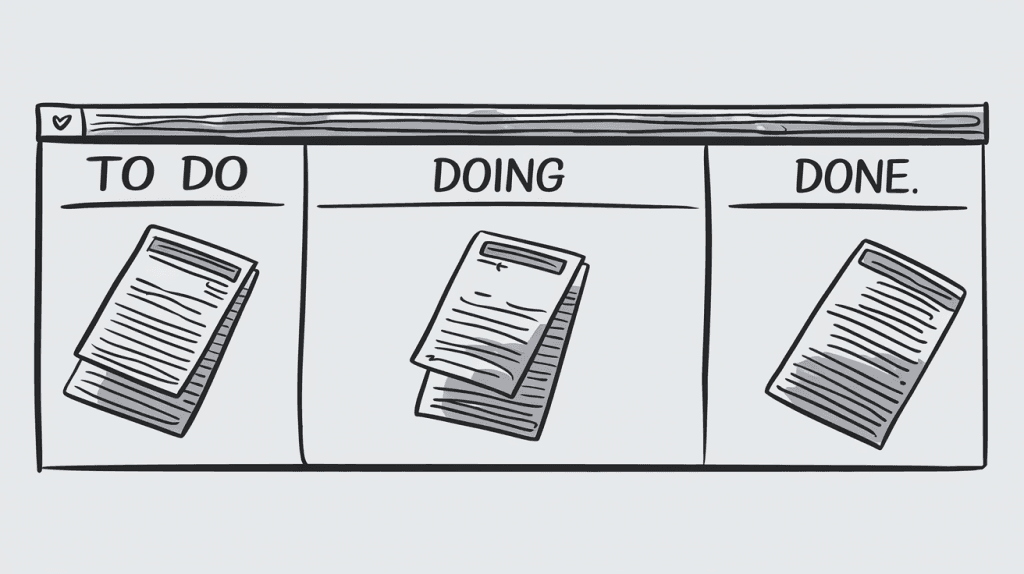
Tools like Kanban boards and burn-down charts provide visual support and facilitate project management by offering transparency and real-time updates on project status.
Quality Management
Instead of rigid quality matrices and control charts, agile teams focus on Definition of Done, continuous improvement, and acceptance criteria to ensure quality.
Project Management Office (PMO)
An agile PMO supports teams, promotes agile learning, and provides a central point of contact for best practices, coaching, and support.
Each of these points reflects how agility can simplify classic project management by emphasizing collaboration, customer feedback, and iterative delivery rather than extensive documentation. Agile approaches are not just an alternative but can also be seen as a complement to traditional methods to create a project management that combines the best of both worlds.
Explanation of Agile Terminology:
- Vision: In the agile context, the vision is a brief statement of the project's end goal. It describes the value the product or project should bring to end-users and serves as a guiding star for the team.
- Product Backlog: This is an ordered list of all features, functions, technologies, enhancements, and bug fixes that could be made to the product. It is a living document that evolves with the project.
- Sprint Zero: The term refers to an initial period during which project preparation takes place. Here, basic requirements are gathered, the environment is prepared, and everything necessary for the start of the first development iteration, the Sprint, is set up.
- User Stories: Short, simple descriptions of a feature from the end-user's perspective. They are intended to ensure that the team remains focused on user needs.
- Epics: Large User Stories that need to be broken down into smaller ones. They are often too complex to be completed in a single Sprint and therefore need further refinement.
- Release Planning: A schedule that determines when and how often the team will deliver releases. It's about finding a balance between frequent deliveries and the availability of features.
- Sprints: Iterations during which the team works on a set of Backlog items to bring them to a shippable state by the end of the Sprint.
- CI/CD Pipelines: Continuous Integration and Continuous Deployment are practices that ensure code changes are regularly tested, integrated into the main branch, and automatically deployed to production environments.
- Daily Stand-up: A daily brief meeting where each team member reports what they did yesterday, what they will do today, and if there are any impediments.
- Retrospectives: Meetings at the end of a Sprint where the team discusses what went well, what could be improved, and what concrete steps should be taken next.
- Backlog Refinement: The process of backlog maintenance. Here, User Stories are reviewed, refined, and re-prioritized to ensure the backlog remains current and actionable.
- Risk Buffer: Time or budgetary reserves included in the project plan to address unexpected challenges or changes.
- Kanban Boards: Visualization tools that display the workflow and allow progress of tasks to be tracked in real-time.
- Burn-down Charts: Graphs that show a team's progress relative to time, indicating how much work remains to be done by the end of the Sprint.
- Definition of Done (DoD): A clear and precise list of criteria that define when a task or product is considered complete.
- Agile PMO: A unit that supports the implementation of agile practices within the organization by providing resources, training, and serving as a point of contact for agile practices.
These terms represent the cornerstones for supplementing or transforming classic project management with agile practices. By familiarizing themselves with these concepts, project managers and product owners can make their projects more effective and adaptable.

Mario Lohe
General Manager with 15+ years of experience in business operations, agile transformation, and AI enablement. Former Director of Operations at Havas Creative Group, Head of Operations at Audiencly. Certified: CSPO, CSM, ISO 31000, Systemic Coach (DCA).